
There are places you visit…
and there are places that stay with you long after you leave.
In the heart of Gujarat’s Rann, on an island called Khadir Bet, I arrived at a place the world knows as Dholavira.
But the locals don’t begin the story with that name.
For them, it has always been Kothdi Tibba—a mound, a quiet rise in the land, a place that held secrets long before the world came looking for them.
Walking through Kothdi Tibba didn’t feel like visiting ruins. It felt like stepping into a memory that refuses to fade.
This was once a thriving city of the Indus Valley Civilization, nearly 4,500 years old. A place where people didn’t just survive—they understood how to live with precision.
Water reservoirs carved with intelligence.
Streets laid out with intention.
Structures that spoke of planning, discipline, and vision.
In a land where water is everything, they had already mastered it.
And yet—
they disappeared.
No clear answers.
No final chapter.
Just silence… and structures that still stand.
But what made this experience unforgettable wasn’t just the past.
It was meeting someone who had lived close to it.
Shambhudhan Gadvi, more than 90 years old—a man who had seen this place before it became a world heritage site, before it had a name recognized globally.
He spoke of a time when there were no roads here. When people crossed the Rann on camels. When this wasn’t a destination—just part of everyday life.
Before archaeologists arrived, before recognition came, it was the villagers who protected this land.
When researchers finally came, they didn’t stay in hotels. They lived in local homes, ate with families, and slowly—together—they revealed this ancient city to the world.
That’s how Kothdi Tibba became Dholavira.
I spent days there.
Walking through silence.
Sitting with stories.
Trying to understand a civilization that had figured out so much… and yet left without explanation.
And then, I moved forward.
From the past… into something entirely different.
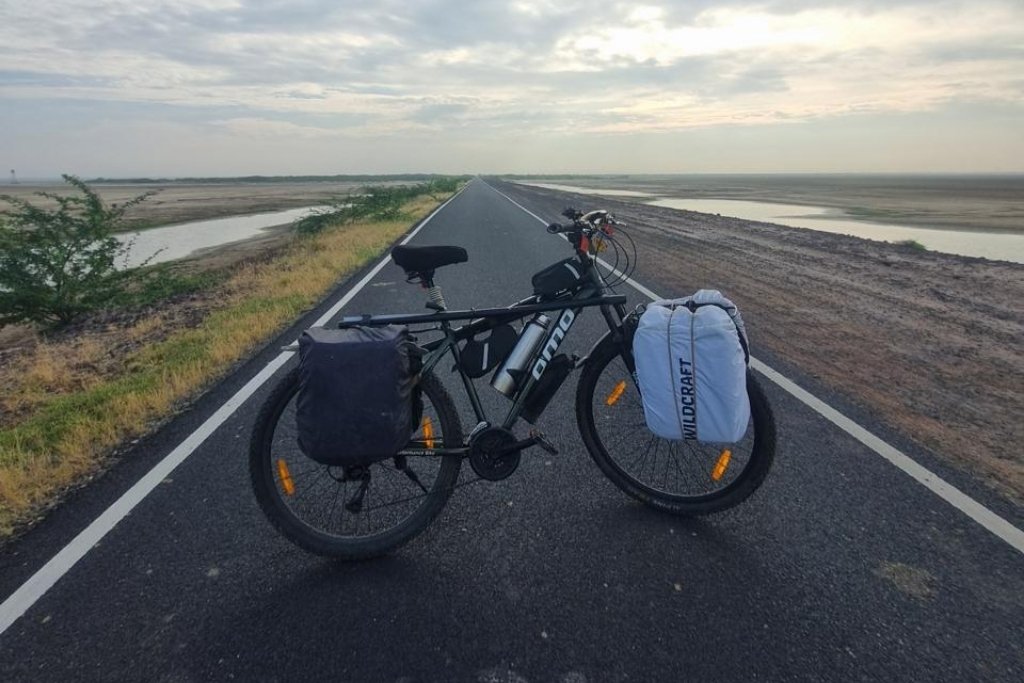
From Dholavira, I started cycling deeper into the Rann of Kutch.
At first, the road ahead looked simple—a straight line cutting through vast openness.
But the Rann doesn’t reveal itself immediately.
It waits.
Soon, the landscape began to change.
Water appeared—on both sides of the road. Endless. Still. Reflective.
This was the Great Rann of Kutch—a land shaped by time, once part of the sea, now a seasonal salt desert.
Fed in part by rivers like the Luni River, which lose themselves here.
People come here to see the famous white desert.
I didn’t.
There was no white Rann when I arrived. Only water.
Climate had changed the scene.
There is a stretch people call the “Road to Heaven.”
But cycling there told a very different story.
No tourists.
No movement.
Only wind—strong, direct, and unrelenting.
A 40 km stretch turned into something endless.
Five to six hours passed… and still the road didn’t seem to end.
The sun above.
The wind against.
No shade.
No shelter.
Only effort.
And then something surreal happened.
Thousands of mosquitoes.
They covered my arms, my clothes…
But they didn’t bite.
In that vast silence, even this felt unreal.
From Kothdi Tibba to the endless Rann, this journey wasn’t just about distance.
It was about contrast.
An ancient city that mastered survival…
and a modern road that still demands it.
I spent days there. And there is so much more to tell.
But if you are reading this as part of my journey from the roads, this is what I want you to take with you:
You don’t just travel through places.
You travel through time… through struggle… and through parts of yourself you never knew existed.